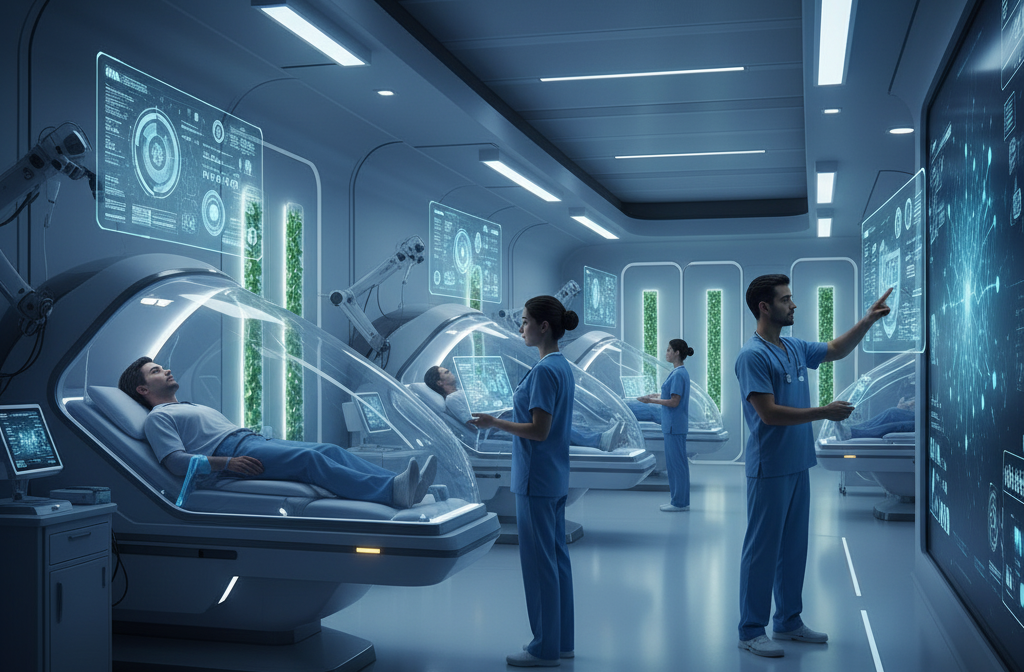
The Modern ICU For Innovations, Impact, and the Future of Critical Care
How technology is changing the intensive care units in worldwide: AI monitor, ICUs, robotics, precision medicine, and data integration, the evolution of critical care, the balance between the technology and compassion, and the ethical challenges shaping the next generation of healthcare, offering a glimpse into the future of critical care excellence.
Table of Contents
- Introduction
- Evolution of Intensive Care
- Key ICU Technologies
- AI & Data Integration
- Human-Centered Care
- Future Trends in Critical Care
- Conclusion
1. Introduction
In Every hospital has the Intensive Care Unit, where the management of the life and death. The ICU that was once a past resort area has now turned into a vital part of modern healthcare, combining with technology, interdisciplinary cooperation, and tender-loving care to help the most critically ill patients.
The modern ICU, equipped with the AI-driven monitoring, ICUs, precision medicine, robotic assistance, and other high technologies, is not just a place for machines and alarms anymore. It has become the data-driven, patient-centered ecosystem that showcases the utmost medical innovation.
2. Evolution of Intensive Care: From Survival to Optimization
The Origins of Critical Care
The concept of intensive care emerged in the mid-20th century, largely spurred by the polio epidemic of the 1950s. Patients who required continuous mechanical ventilation led to the creation of specialized wards in the early ICUs, which were designed for round-the-clock monitoring.
By the 1970s, ICUs had become standard in hospitals worldwide. However, their primary focus was survival. Early systems lacked the advanced tools we now take for granted in the real-time monitoring, data integration, and automated alerts, which were still futuristic dreams.
The Shift Toward Comprehensive Critical Care
Modern ICUs now go beyond simply keeping patients alive. They can focus for early detection, personalized treatment, and long-term recovery outcomes. The integration of the technology with evidence-based medicine has made possible to predict complications before they occur, reduce hospital-acquired infections, and even manage patients remotely.
3. Key ICU Technologies
To get a sense of how advanced the modern ICU is, we can consider some of its most important elements:
3.1 Advanced Monitoring Systems:
Traditional ICUs were monitored largely by manual observation and simple vital sign machines, but today, AI-powered monitoring systems gather and process patient data in real time to identify minute changes in physiology that may indicate a decline, such as wearable sensors and wireless monitors that track heart rate, blood pressure, oxygen saturation, and even biochemical markers that are constantly processed by algorithms to alert clinicians before a crisis occurs.
3.2 Smart Ventilation and Life Support:
Mechanical ventilators have evolved since their inception, with modern ventilators utilizing adaptive algorithms that alter air pressure, oxygen levels, and timing based on patient-specific lung mechanics, and closed-loop systems that can synchronize with a patient’s breathing efforts to enhance comfort and outcomes.
Likewise, extracorporeal membrane oxygenation (ECMO) and dialysis machines have become increasingly sophisticated, with AI-powered devices that can adapt to a patient’s needs in real time.
4. AI & Data Integration
4.1 Internet of Medical Things (IoMT)
The IoMT connects smart medical devices to secure networks for the sharing of data and automated alerts, such as with connected infusion pumps, wearable ECGs, and wireless ventilators, reducing human error and creating a feedback loop for continuous data that enhances both acute and post-ICU care.
decisions more quickly and more accurately as machine learning models improve with additional data.
4.2 Tele-ICU systems
Telemedicine is not just for outpatient care, however. With tele-ICUs, off-site critical care specialists can remotely monitor multiple patients via live video feeds and digital dashboards, which is particularly beneficial in rural areas where ICU specialists are in short supply. Tele-ICUs are shown to improve survival rates, shorten response times, and provide continuous oversight.
5. Human-Centered Care
Beyond Technology: Compassion in the ICU
- While machines and digital systems have flooded into the ICU, the human element of compassion is still critical, because patients are often sedated, frightened, or unable to communicate.
- Modern ICUs tend to focus on the physical, emotional, and psychological needs of patients, including open visitation policies, virtual communication tools for families, and patient diaries that help maintain a sense of connection and dignity.
- Modern ICUs incorporate family-centered models of care that engage families as part of the treatment team and include them in discussions, treatment options, and decision-making; studies have demonstrated that this approach decreases anxiety and enhances recovery.
- Post-ICU Syndrome (PICS) is a constellation of physical debility, cognitive impairment, and PTSD-like symptoms that is now a major area of interest. Today, modern ICUs incorporate early mobilization, mental health support, and rehabilitation.
6. Future Trends in Critical Care
6.1 Tailored, Precise Critical Care
Genomics, biochemical, and physiological data will enable treatments that are personalized to each patient, and precision medicine will enable optimal drug dosages and responses with minimal side effects, for instance identifying patients at higher risk for drug toxicity or complications so that preventive measures can be taken.
6.2 Smart ICU Rooms
Imagine a room that automatically adjusts lighting to support circadian rhythms, temperature to minimize stress, and sensors that track movement or distress via AI and IoT.
6.3 Augmented and Virtual Reality
AR and VR are already being used for training ICU staff and for rehabilitation of patients, and VR can reduce anxiety, manage pain, and allow a patient to get up and move around while still in bed.
6.4 Augmented Human Workforce
AI will augment the abilities of clinicians, not replace them. Intelligent systems will be integrated into the ICU environment.
7. Conclusion
For in the coming decades, as artificial intelligence merges with human intuition, as predictive analytics partners with compassionate care, and as sustainability joins hands with science, the ICU will continue to evolve-not a last line of defense but a beacon of healing and hope.


Post Comment