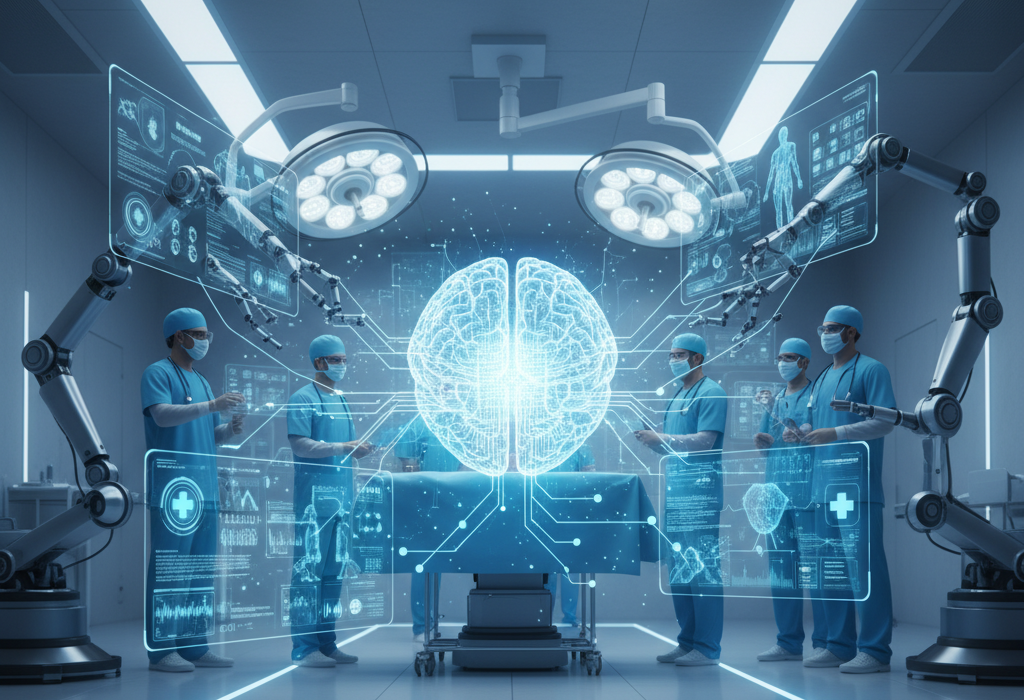
Artificial Intelligence in Healthcare
Artificial Intelligence has emerged as one of the most transformative technologies of the 21st century and is fast changing industries while redefining our ways of life and work. Probably its the most promising application one that has the potential for great impact in the healthcare, a domain touching the life of every human being. From the early disease for detection to personalize treatment plans, robotic surgeries, and administrative automation, AI is revolutionizing the delivery of medical services
Table of Contents
-
- Artificial Intelligence in Healthcare: Understanding
- Key Applications of AI in Healthcare
- Benefits of Artificial Intelligence in Healthcare
- Challenges and Limitations of AI in Healthcare
- Artificial Intelligence in Healthcare: The Economic Impact
- Preparing for an AI-Driven Healthcare Future
- Conclusion
1. Understanding Artificial Intelligence in Healthcare
In the Artificial Intelligence refers to the capacity of machines to mimic human cognitive processes like learning, reasoning, problem-solving, and reaching decisions. In the healthcare, AI involves algorithms and the software developed to analyze complex medical data with the express purpose of assisting healthcare professionals and improving the outcomes for patients.
Unlike traditional systems, AI software learns from experience by processing massive volumes of healthcare information, such as images, genetic information, clinical notes, and patient histories, to identify patterns that a human may never observe. The findings can then be used to potentially drive diagnosis, prediction of disease progression, or treatment options.
2. Key Applications of AI in Healthcare
The potential of AI ranges from diagnosis and treatment to research and administration in every corner of healthcare. Below are some of the major applications reshaping the field today.
2.1 Disease Diagnosis and Detection
The most of the powerful contributions of the AI can involve medical imaging and diagnostics. The Machine learning algorithms can analyze for X-rays, CT scans, MRIs, and ultrasound to identify anomalies with accuracy equal to, or even surpassing, that of human specialists.
2.2 Predictive Analytics and Risk Assessment
The Predictive AI models can enable the healthcare providers to the foresee patient outcomes and recognize risks before they become critical. Optimize staffing and resource allocation based on predicted patient inflow.
2.3 Personalized Medicine
AI now empowers treatments of precision medicine-that is, therapies tailored according to the genomics, lifestyle, and environmental background of each individual. By interpreting the genomics data, AI can reveal the exactly how specific genes impact drug response or disease susceptibility.
3. Advantages of Artificial Intelligence in Healthcare
Overall, AI provides a wide range of advantages in regards to improving quality, increasing accessibility, and making healthcare more affordable.
3.1 Improved Diagnostic Accuracy
Because of the AI technologies can analyze millions of data points to identify trends in data that are not visible to the human clinicians, more accurate and the timely diagnoses are possible.
3.2 Cost Reduction
AI cuts the operational costs through the reduction for errors and smoothing of workflows, and acceleration of drug development.
4. Challenges and Limitations of AI in Healthcare
With all its great potential, AI integration in healthcare faces many challenges. Recognizing these is important for responsibly harnessing all the advantages offered by AI.
4.1 Data Privacy and Security
Health data is rather sensitive. The AI systems require a lot of patient data to train and it can involve the risks of data disclosure, data misuse, or compliance with specific regulations such as HIPAA or GDPR.
4.2 Algorithmic Bias and Fairness
AI models are only as good as the data they learn from. If the training data sets lack diversity, then algorithms have the potential to produce biased results, greatly impacting particular demographic groups or populations.
4.3 Lack of Explainability
Most AI systems, especially those using deep learning, are designed as “black boxes” that offer little transparency into their decision-making processes.
5. Economic Impact of AI in Healthcare
The AI can promises not only the medical transformation but also large economic benefits. Reports suggest that AI could save the global healthcare industry more than $150 billion annually by 2026 through better efficiency and outcomes.
The areas of financial impact include:
- Reduced hospital readmissions
- Reduced diagnostic cost.
- Accelerated drug discovery timelines.
- Automated the administrative workflows.
6. Preparing for an AI-Driven Healthcare Future
Interdisciplinary collaboration between technologists and medical professionals. Public awareness to engender trust and transparency in the use of AI. The Policymakers must also update the regulations to improve innovativeness while protecting patient safety and rights.
7. Conclusion
Artificial Intelligence is innovating health care from the grassroots. AI links data-driven insights with human expertise, empowering clinicians, hastening discoveries, and offering personalized care for patients on an unparalleled scale. The impact ranges from predictive analytics and robotic surgery to mental health support and drug discovery along the full continuum of care. Yet, tremendous potential brings tremendous responsibility.
The future of AI in health will depend on ethical deployment, regulatory clarity, and human-centered design. Used responsibly, AI can make healthcare more precise, accessible, and compassionate on the road to a healthier, smarter world.


Post Comment