Bone Fractures For the Types, Symptoms, and Effective Treatments
Bone fractures are the breaking of bones or the cracking of bones due to trauma, overuse, and various pre-existing conditions, such as osteoporosis. To be able to properly treat and recover from a fracture, understanding of the different kinds of fractures-simple, compound, and stress-is highly necessary. Common symptoms include pain, swelling, bruising, and reduced mobility in the injured area.
Accurate diagnosis by means of X-rays or scans is crucial for determining the optimal treatment plan, which may range from casting and surgical methods to physical therapy. Most cases of bone fracture respond well to proper medical intervention combined with rehabilitation, thereby recovering their strength and function. Learn how to recognize, treat, and avoid fractures of the bones effectively.
Table of Contents
-
- Introduction
- Anatomy of the Human Bone
- Causes of Bone Fractures
- Types of Bone Fractures
- Signs and Symptoms of Bone Fractures
- Bone Fracture Diagnosis
- Conclusion
1. Introduction
Bone fractures are one of the most common injuries that humans suffer from. They can happen to people of all ages, from children to elders. A fracture is quite consequential in causing a change in mobility, daily functions, and health. In its basic definition, a bone fracture means the breaking or cracking of the continuity in the bone structure.
Although bones are sturdy and engineered to withstand a great deal of stress, they do have their breaking point. Repeated force, sudden trauma, or weakened bone density-all of these can lead to the occurrence of a fracture. Understanding how and why these injuries occur, their types, and the most viable treatment options will help in proper care and recovery.
The detailed structure of the bones, the causes and symptoms of the fractures, and the many forms for the treatment and recovery options available in modern medicine are some of the topics we will discuss in this manual. You will be thoroughly acquainted with how one can accurately identify, efficiently handle, and avoid bone fractures by the end.
2. Anatomy of Human Bone
To understand fractures of the bones, one needs to understand first what bones are made of and how they work.
Bones are living tissues that, throughout life, constantly regenerate. They provide structural support, protect vital organs, anchor the muscles, and store essential minerals like calcium and phosphorus.
Each bone consists of three main layers:
- Periosteum: Thin, outer layer that nourishes the bone via blood vessels and nerves.
- Compact Bone: The dense, hard layer responsible for strength and rigidity.
- cancellous (spongy) bone: The spongy, porous tissue inside the ends of some of your bones that contains bone marrow; produces blood cells.
Bone Composition
Bones are made of:
- Collagen fibres provide tensile strength and elasticity.
- Calcium phosphate crystals: It provides hardness and rigidity.
- Bone cells: responsible for building-osteoblasts, resorption-osteoclasts, and mature cells-osteocytes that maintain the tissue.
Bone Remodeling
Bone constantly undergoes a natural process called remodeling, wherein old bone tissue is replaced by new tissue. This process helps repair microdamage and maintain bone strength. With the compromise in bone health caused by age, changes in hormone levels, or disease, fracture risk rises remarkably.
3. Causes of Bone Fractures
The Bone fractures have many different causes and are into three broad categories: trauma, overuse, and pathological conditions.
1) Traumatic Fractures: It is cause by sudden, forceful impacts such as:
- Falls are the most common cause, especially in older adults.
- Vehicle accidents: High-speed collisions often result in multiple or complex fractures.
- These include: Sports injuries: Many bone fractures happen with intense physical activity, especially in contact sports.
In the Workplace accidents especially in construction sites or heavy machinery places.
2) Stress or Overuse Fractures: These develop gradually over a period of time from repetitive motion or overuse. It is Common among for the athletes, dancers, and military personnel, tiny cracks form due to repetitive strain with too little rest periods.
3) Pathological Fractures: These occur in bones weakened by underlying diseases such as:
- Osteoporosis is the most common cause of fragile bones in older adults.
- Osteogenesis imperfecta: In the brittle bones caused by this genetic disorder.
- Nutritional deficiencies: In the Inadequate intake of calcium, vitamin D, or protein can contribute to bone fragility.
4. Types of Bone Fractures
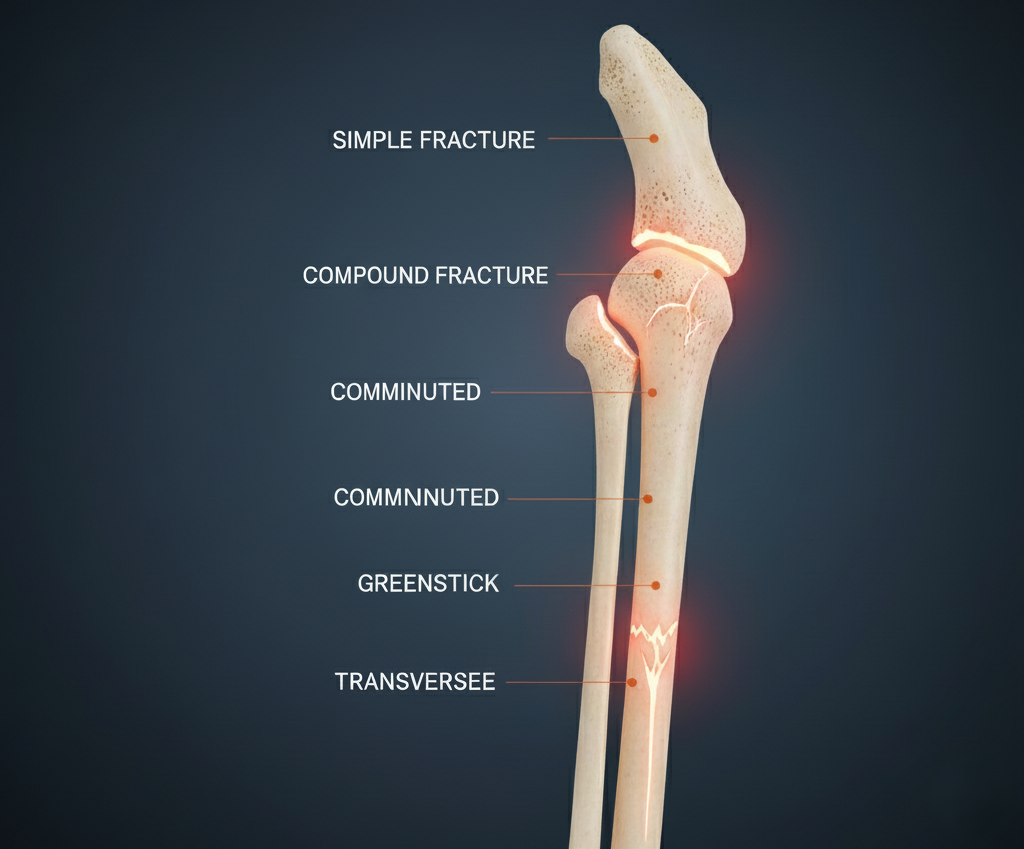
The Fractures are classified based on the way the bone breaks and the pattern of the break, and whether the skin and surrounding tissues are involved.
Below are some of most common types:
1) Closed Fracture: The bone fractures but does not break through the skin. It stays internal and is usually less prone to infection.
2) Compound (Open) Fracture: The bone breaks through the skin, causing an open wound. These fractures are more serious and carry a high risk for infection.
3) Transverse Fracture: A straight horizontal fracture across the bone, usually caused by a direct impact.
4) Oblique Fracture: This usually occurs at an angle across the bone, which is generally due to a sharp-angled force.
5. Signs and Symptoms of Bone Fractures
It is important to recognize the signs for fracture in order to seek immediate treatment. Symptoms that may vary depend upon the bone injury.
In the Severe pain for the injury site, especially during movement
- Swelling and tenderness around the affected area
- Bruising or discoloration of the skin
- Deformity or misalignment of the limb or the joint
- Inability to move the affect for part normally
- Grinding or cracking sound (crepitus) at the time of injury
- Bleeding, in the case of an open fracture
6. Diagnosing bone fractures
For the Timely and accurate diagnosis is the important for the effective treatment. The diagnostic process usually includes:
1) Physical examination: The doctor examines the injured area for swelling, deformity, bruising, and range of motion. The doctor may also check for nerve or blood vessel damage.
2) Imaging Tests
- X-ray: the most commonly used imaging modality to visualize bone fractures and alignment.
- CT (Computed Tomography): Provides detailed 3D images useful for complex or joint fractures.
- MRI: It shows soft tissue damage and stress fractures, which may not be visible on an X-ray.
- Bone Scan: This is used to identify small or hidden fractures, especially those related to stress.
7. Conclusion
The Bone fractures are common, but they should never be taken lightly for the Understanding the types of fractures, symptoms, and treatment allows one to take quick action for the best recovery. With improved diagnostic imagining, surgical techniques, and rehabilitation therapies, most are able to return to full strength and mobility following a fracture. It is very important in prevention to maintain bone health through proper diet and exercise, and by following good lifestyle habits. Any fracture, from the simplest stress fracture to the most complicated break, relies on early diagnosis, appropriate treatment, and rehabilitation consistently to restore bone integrity for long-term wellness.



Post Comment