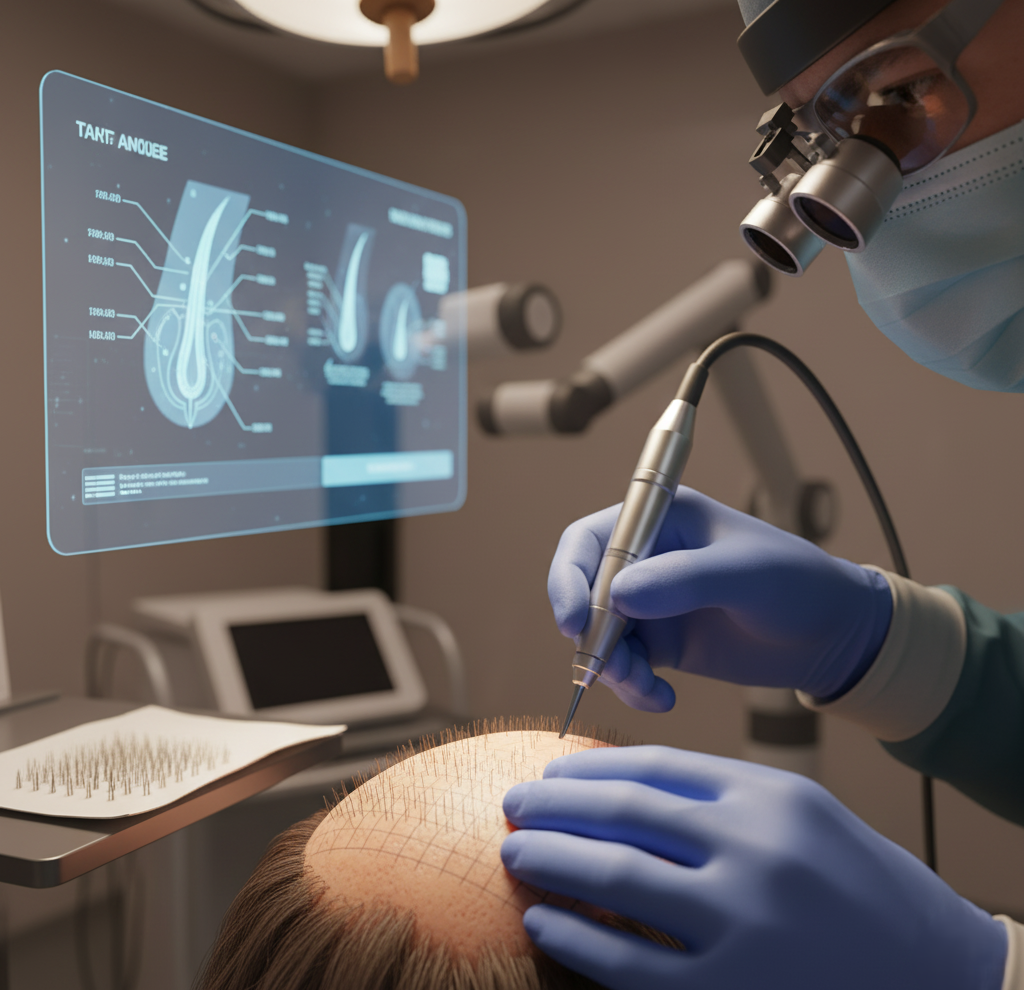
Explore For the Art and Science Behind Hair Transplants
It can explore the ideal blend of medical precision and the aesthetic that can defines modern hair restoration. This blog will show how state-of-the-art surgical techniques, new technologies, and artistic judgment combined to produce natural-appearing results.
By investigating the patterns of hair growth, and the latest developments in FUE and DHI, readers will obtain an overview of the intricate life-changing procedure. Learn how skilled surgeons combine creativity with science to achieve far more than just the restoration of hair in this modern landscape of advanced cosmetic solutions: enhanced confidence, identity, and self-esteem.
Table of Contents
-
- Introduction
- Understanding Hair Loss: Causes and Myths
- The Evolution of Hair Transplant Techniques
- The Science Behind Hair Transplants
- Technology and Tools Shaping Modern Procedures
- Surgical Procedure: A Step-by-Step Explanation
- Care and Healing after Transplantation
- Choosing the Right Surgeon and Clinic
- Future of Hair Transplants
- Conclusion
1. Introduction
Hair is much more than just a few strands coming out of the scalp: it is an identity, a manifestation of confidence, and self-expression. When lost, it can be as if one is losing a part of their identity. That is why hair transplants are not just mere medical procedures in today’s era. They combine the precision of science with the imagination in artistry.
Each successful transplant is a victory not only medically but also aesthetically. It requires the surgeon to understand angles, density, and symmetry, much like artists, while commanding surgical precision based on biological and technological know-how. It is not just about growing hair back; the goal is to make it as natural-looking as possible-to restore both appearance and self-confidence.
2. Understanding Hair Loss: Causes and Myths
Before answering how transplantations are done, it is necessary to understand why hair loss occurs. The most common cause is androgenetic alopecia, or genetic pattern baldness, affecting both men and women. Over time, hormones such as DHT, produced in the body, shrink hair follicles and can cause thinning and eventual hair loss.
Other factors include:
- Stress and hormonal imbalances
- Nutritional deficiencies
- These include medical conditions like thyroid disorders or alopecia areata.
- Environmental factors and even hairstyling habits
3. The Evolution of Hair Transplant Techniques
Hair transplant surgery has dramatically changed from its early, experimental stages. The first operations in the 1950s used large grafts and had a characteristic “pluggy” look which was quite identifiable.
The 1990s saw the introduction of Follicular Unit Transplantation, which was another breakthrough that concentrated on the transplantation of natural follicular units rather than large grafts. This technique yielded more natural-looking results but still presented a linear scar.
When FUE was introduced in the 2000s, the game changed entirely. Surgeons could, for the first time, extract individual follicles with the use of micro-punch tools. Consequently, it can minimized the scarring and recovery time. The result? Hair that looked and felt completely natural.
In 2020s, The combining robotic-assisted systems with AI-guided mapping has taken transplants to unparalleled levels of precision. Each step in this evolution reveals scientific innovation and aesthetic refinement, a flawless merger of technology and human expertise.
4. The Science Behind Hair Transplants
Hair growth is an interesting aspect of biology. These units are mainly derived from the “donor zone” areas around the back and sides of the head, which are genetically resistant to DHT.
Here’s the key scientific principle :
When follicles are transplanted from these DHT-resistant areas to balding zones, they retain their resistance, meaning they’ll keep growing permanently in their new location.
Science doesn’t stop there. Surgeons must consider:
- Growth cycle stages: anagen, catagen, telogen
- Blood supply and oxygenation
- Scalp elasticity and density distribution
5. Technology and Tools Shaping Modern Procedures
In the Innovation is indeed the backbone of modern hair restoration. Today’s transplants depend upon tools that render procedures safer, faster, and more precise.
Key technologies that can include:
- Robotic systems, such as ARTAS: These automate the follicle harvesting with pinpoint accuracy.
- Microdissection instruments: It is Used to separate the follicular units without damage.
- Sapphire blades offer finer cuts, causing less trauma and enhancing recovery.
- AI and 3D Imaging: Assist in mapping the ideal placement of grafts for natural-looking results.
Technology also enhances the consultation stage. This is use of digital simulations allows the patient to view the potential outcome prior to surgery and gives them a real idea of what to expect, thereby instilling confidence in the whole process.
6. The Surgical Process: Step-by-Step Overview
1) Consultation and Planning: The surgeon assess for hair density, the quality of the donor, and the desired outcome. A personalized design is drawn, marking graft areas and designing the new hairline.
a. Anesthesia: The anesthesia is local, meaning the patient feels absolutely no pain while still remaining awake.
b. Harvesting: In FUT, a strip of scalp is removed and dissected into follicular units. In FUE, individual follicles are extracted directly using tiny punches-0.8 to 1 mm in size.
2) Graft Preparation: Technicians prepare grafts and count them under microscopes, while taking care that each unit remains viable.
3) Creation of Recipient Sites: The surgeon delicately creates micro-incisions where grafts will be implanted. This constitutes the real “art” of the procedure, as the natural look is completely dependent on it.
4) Implantation: hair grafts are implanted one by one, respecting natural growth direction and density.
5) Post-Procedure Dressing: The scalp is cleaned and lightly bandaged. Most patients can go home the same day.
A painstaking process, to be sure-one that can take several hours but is well worth the lifelong change.
7. Care and Healing after Transplantation
- The healing journey is just as crucial as the surgery itself. Immediately following the operation, there might be mild swelling, redness, or scabbing, with all normal and temporary.
- The first week consists of gentle washing and avoidance of sun exposure or strenuous activity.
- Transplanted hair may shed within two to three weeks with a normal phase called “shock loss.” Don’t be worried; this is just the adjustment of follicles.
- Within the third month, new hair starts to appear.
- By six months, visible growth is noticeable.
8. Selecting the Correct Surgeon and Clinic
The Success in a hair transplant depends heavily on the surgeon’s expertise. It is from here that the “art” truly comes into play: the surgeon must envision natural flow, angle, and distribution while making a perfect blend with existing hair.
Here’s what to look for:
- Board certification and specialized experience
- Before-and-after photos of actual patients
- Transparent consultations around expected outcomes
- Modern equipment and sterile facilities
Stay away from clinics that offer very low prices or promise unrealistic things. It has qualified and responsible surgeon will avoid shortcuts to ensure safety and natural results.
9. The Future of Hair Transplants
The future of hair restoration is bright, and it is the accelerating so fast. The Researchers are looking into the following:
- Stem cell hair cloning: New follicles cultured in the lab for unlimited donor supply.
- Platelet-rich plasma therapy: improving growth and healing naturally. Artificial intelligence to map individual scalp patterns to allow hyper-precise graft placement.
We’re in the entering an era where the non-invasive regrowth therapies and the bioengineer follicle will make baldness a choice, not a destiny.
10. Conclusion
Every follicle being transplanted tells a story of patience, hope, and transformation. It’s about looking into the mirror and recognizing yourself again, stronger, happy, and with more confidence than ever.



Post Comment